Where to put a cat litter box, and how much space does it need?
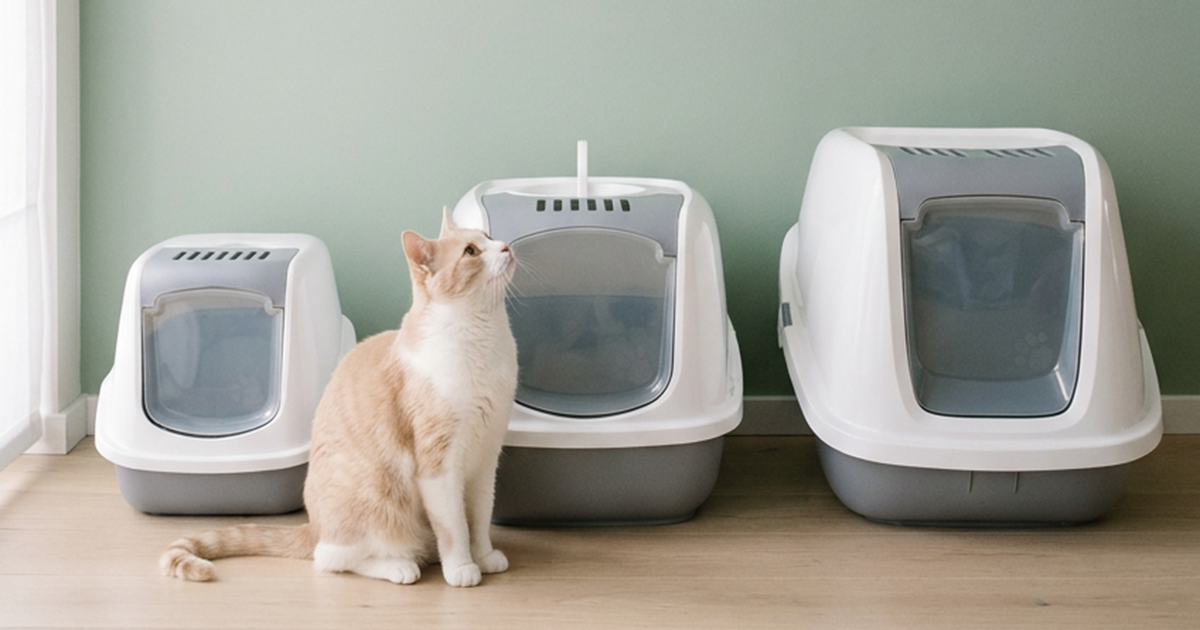
Where to put a cat litter box, and how much space does it need?
Most litter boxes end up where they are least visible. In the laundry room. Behind the bathroom door. Under the stairs.
But the place that works best for your room is not always the place that works best for your cat.
So where should you put a cat litter box?
Choose a quiet, easy-to-reach spot, away from food and water. Your cat should be able to enter and leave without feeling trapped or surprised. You also need enough room for the litter box itself, for your cat to step in and out, and for you to clean it comfortably.
In this guide, we look at where to put a cat litter box, which places are best avoided, what changes with a covered box and how to work out how much space your cat needs.
Why does the spot matter as much as the litter box?
Cats can feel vulnerable when they use their litter box. A busy, noisy or hard-to-reach spot can make a visit stressful. A calm place that your cat can always reach and leave easily is a better choice.
Cats often feel more comfortable when they can see what is happening around them. Your cat should not have to pass something that may frighten her to reach the box. She should also be able to leave easily after using it.
The location matters for you too.
A litter box that is easy to reach is also easier to check and clean every day. And cleanliness matters. Cats generally prefer a clean litter box. Owners do too. A rare moment of complete agreement between species.
If your cat suddenly starts to go to the toilet outside the litter box, speak to your vet.
A change in toilet habits can have a medical cause.
Where should you put a cat litter box?
There is no single room that is right for every cat.
A bathroom can work. So can a bedroom, living room or quiet corner of another room. What matters is not the name of the room, but what happens around the litter box.
Look for a place that is:
- quiet and away from busy walkways
- always accessible, day and night
- separate from food and water
- away from sudden noises, such as a washing machine
- somewhere your cat can enter and leave easily
- private enough for your cat to use without being disturbed
In a home with several cats, also make sure one cat cannot easily block another cat's access to the litter box.
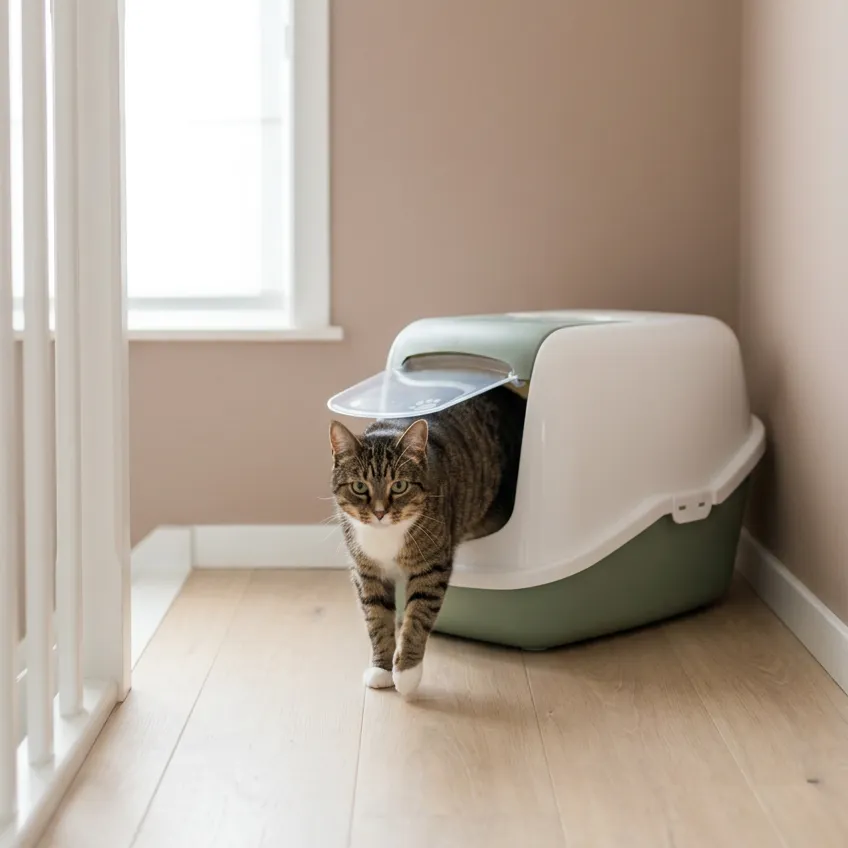
Places that are often less suitable
Next to food and water
Cats generally prefer their toileting area to be separate from where they eat and drink.
Next to a washing machine or noisy appliance
A machine that suddenly starts or vibrates can disturb a cat while she is using the litter box.
In a busy hallway or doorway
People regularly passing close to the litter box can make the area feel less private.
Near a cat flap or large glass door
These can be busy areas. Your cat may also see other cats outside, or be seen by them, which can make some cats feel less secure.
Behind a door that can close
Your cat needs access to the litter box at all times. A good location stops being a good location if the door is closed at night.
The best place is not a specific room. It is the place in your home where your cat has quiet, easy and reliable access to the litter box.
How many litter boxes do you need?
Feline veterinary guidelines commonly recommend one litter box per cat, plus one extra.
- 1 cat: 2 litter boxes
- 2 cats: 3 litter boxes
- 3 cats: 4 litter boxes
Place them in different locations rather than directly next to each other.
Choice matters. One cat may prefer one room at a certain time of day. In a home with several cats, another cat may also be using the box or blocking access to it.
Several boxes in different places give each cat more options.
Does a covered litter box need a different spot?
Covered litter boxes work well for many cats, as long as they are large enough, easy to reach and cleaned regularly.
One small study found no overall preference for covered or open litter boxes when both were kept clean. Individual cats did show preferences, so there is no single type that works best for every cat.
With a covered litter box, pay extra attention to three things.
A clear way out
A covered box normally has one entrance.
Turn the entrance towards an open part of the room rather than towards a wall or narrow gap.
In a home with several cats, make sure another cat cannot easily sit in front of the entrance and block the way out.
A door your cat accepts
Some cats are comfortable pushing through a swing door. Others need time to get used to it.
If your cat hesitates, you can introduce the door gradually or leave it open at first, if the model allows this.
Regular cleaning
Because the inside is less visible, it can be easier to forget that it needs scooping.
Odours can also build up inside a covered box if it is not cleaned regularly.
A filter can help control odours, but it does not replace regular scooping.
Place the box somewhere you can easily open and clean it.
How big should a cat litter box be?
A litter box should give your cat enough room to step in, turn around, dig and find a comfortable position.
As a general guideline, look for a litter box that is around 1.5 times the body length of your cat, measured from the nose to the base of the tail.
For example, if your cat measures 30 cm:
30 cm × 1.5 = 45 cm
A litter box around 45 cm long gives you a useful starting point.
This is a guideline, not a strict rule. Cats differ in size, age and the way they use their litter box.
Watch your cat too. If she has difficulty turning around or regularly touches the walls, a larger box may be more comfortable.
And remember that the dimensions given for a product are normally outside measurements. The usable space inside will be slightly smaller, especially with a covered litter box.
How much floor space does a litter box need?
The litter box itself is only part of the space you need.
Think about three areas: in front of the box, around it and above or in front of it for cleaning.
In front of the box
Leave enough room for your cat to enter and step out comfortably.
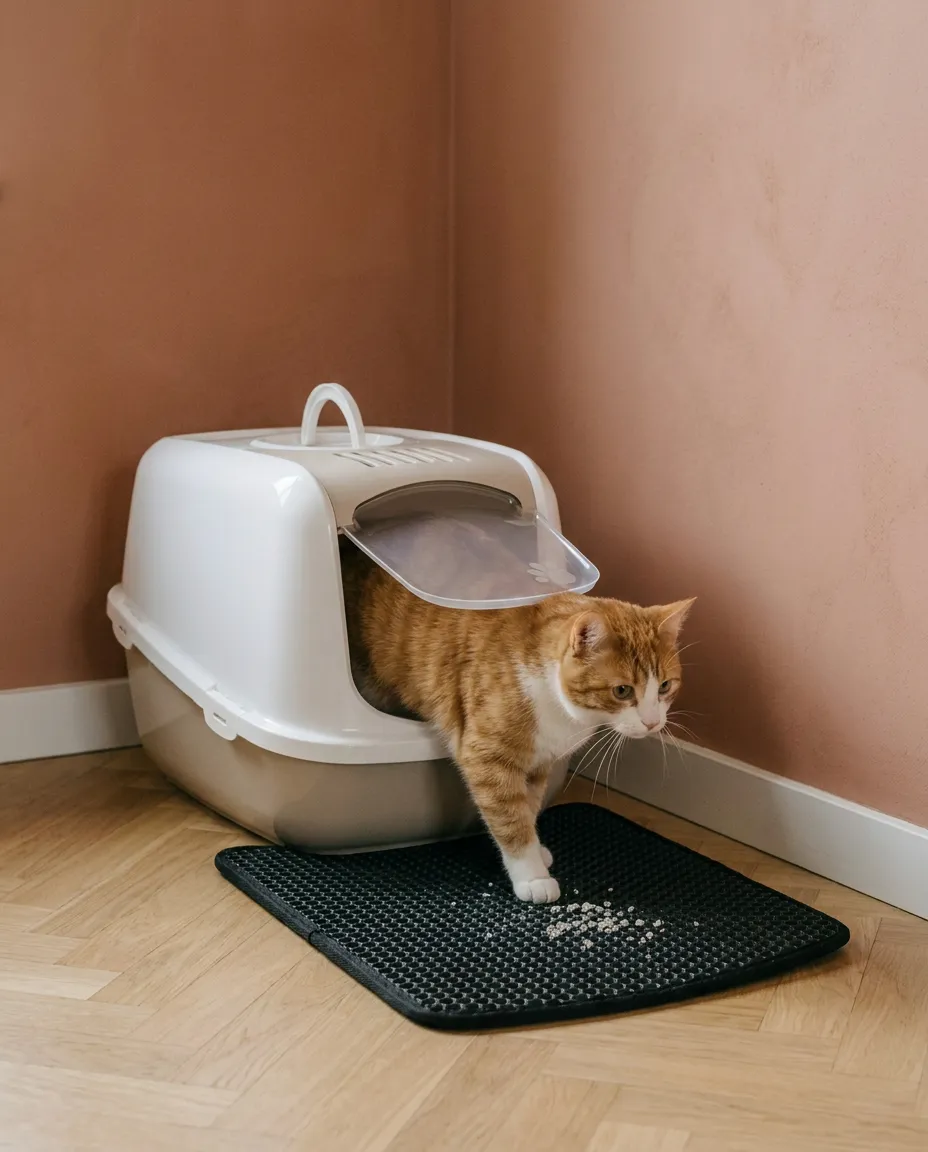
You may also want to place a litter mat in front of the entrance. The Savic Litter Catcher Mat for the Nestor measures 49 × 32.5 cm. That gives you an idea of the extra floor space you may want to keep free in front of the box.
Around the box
You need enough room to scoop and clean without moving the complete litter box every time.
If you have to move furniture or move the box first, daily cleaning quickly becomes a chore.
Above or in front of the box
Check how the litter box opens.
Some covered boxes open from the top. Others have a folding front.
Make sure you can open the box fully where you plan to place it.
Compare litter box sizes
Do not compare litter boxes on length alone.
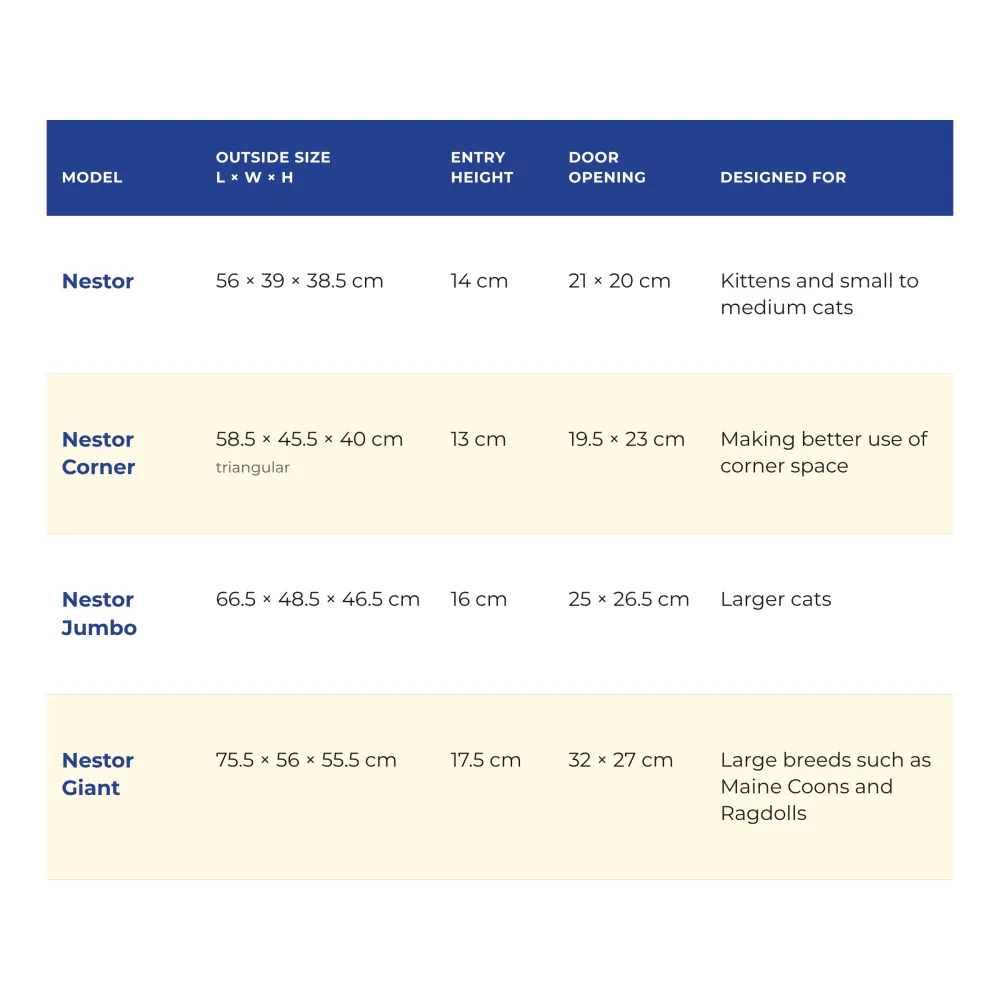
Width determines how much floor space the box takes up. Height matters if you want to place it under a shelf. And for larger cats, the size of the entrance is important too.
The table below compares the four Nestor models. All measurements are outside dimensions.
What if you only have a corner?
A corner can be a practical place for a litter box.
It can offer a quieter position in the room while making use of floor space that might otherwise stay empty.
The challenge is shape.
Put a standard rectangular litter box diagonally into a corner and you often lose space behind it. Push it against one wall and it may stick further into the room.
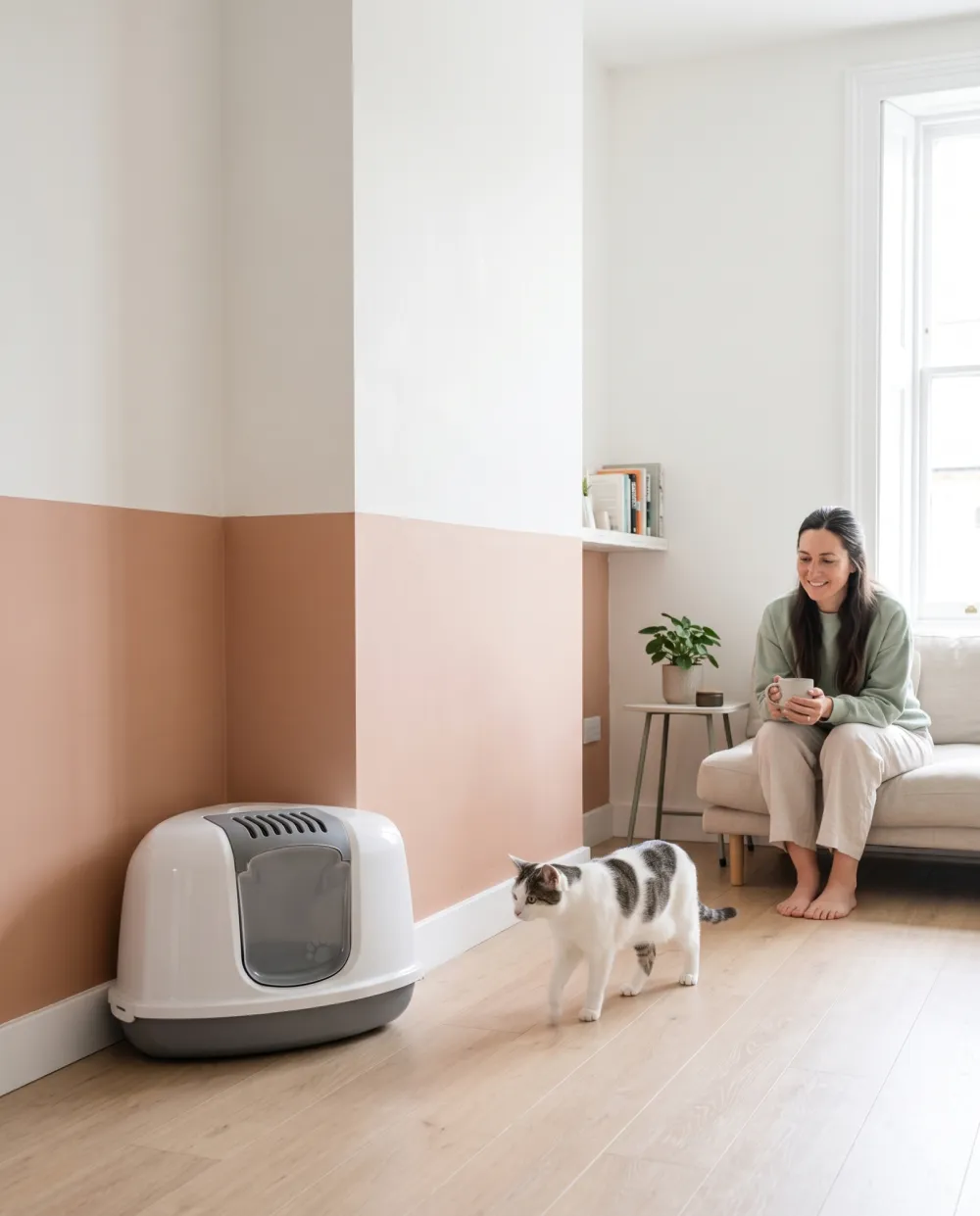
A triangular litter box is designed specifically for this situation.
The Nestor Corner measures 58.5 × 45.5 × 40 cm. Its back follows the two walls of the corner while the entrance faces the room.
That can be particularly useful in smaller homes where every centimetre of floor space counts.
But choose the corner carefully.
A corner behind a swinging door is not a good option. The door could block access or disturb your cat while she is using the box.
What should you put around a litter box?
Put a litter box on a hard, flat floor that is easy to clean.
A stable surface is important. A box that moves when your cat steps inside may feel less secure.
A litter mat in front of the entrance can also help catch some of the litter carried out on your cat's paws.
Will it catch every grain?
No. Cats remain remarkably good at transporting litter into rooms you did not know they had visited.
But a mat can reduce the amount that reaches the rest of the house.
If your cat tends to pee high or towards the back of the box, look for a litter box with a raised back or a design that helps keep urine inside.
The short version
When choosing a place for your cat's litter box:
- Choose a quiet location your cat can always reach.
- Keep the litter box away from food and water.
- Avoid noisy appliances and busy walkways.
- Make sure your cat can enter and leave easily.
- Provide one litter box per cat, plus one extra, in different locations.
- Choose a box around 1.5 times your cat's body length as a useful starting point.
- With a covered box, keep the entrance clear and clean it regularly.
- Allow extra floor space in front of the box.
- Make sure you have enough room to open and clean it.
The best setup is not simply the one that fits the free space.
It is the one that works for your cat, works for your home and stays practical enough to clean every day.
Not sure which type of litter box suits your cat? Read our guide on hooded and open litter boxes next.
Frequently asked questions
Can I put a cat litter box in the bathroom?
Yes. A bathroom can work if it is quiet and your cat can always reach it. Make sure the door cannot accidentally close and avoid placing the box directly beside a noisy washing machine.
Should a litter box be near food and water?
It is better to keep them separate. Cats generally prefer their toilet area away from their eating and drinking areas.
How many litter boxes does one cat need?
A common feline veterinary guideline is one litter box per cat plus one extra. For one cat, that means providing two litter boxes in different locations when possible.
Do cats prefer covered or open litter boxes?
There is no single answer for every cat. Research suggests that many cats have no strong preference when both types are large enough and kept clean, while individual cats may clearly prefer one type. Watch how your own cat uses the box. Her behaviour is the best guide.
How big should a litter box be?
As a general guideline, choose a litter box around 1.5 times your cat's body length, measured from the nose to the base of the tail. Your cat should be able to enter, turn around, dig and settle comfortably without being restricted by the walls.
How much floor space do I need for a litter box?
Start with the outside dimensions of the litter box. Then leave extra space in front so your cat can enter and leave comfortably. Also make sure there is enough room around or above the box for you to open and clean it easily.
About the author
Olivia Maes, Marketing, Savic. Olivia has worked at Savic for more than 25 years. She writes about how product design can make daily life more comfortable for pets and the people they live with.
Savic is a Belgian family business founded in 1953 and based in Heule. Today, Savic pet accessories are sold through wholesalers and distributors in more than 88 countries.

